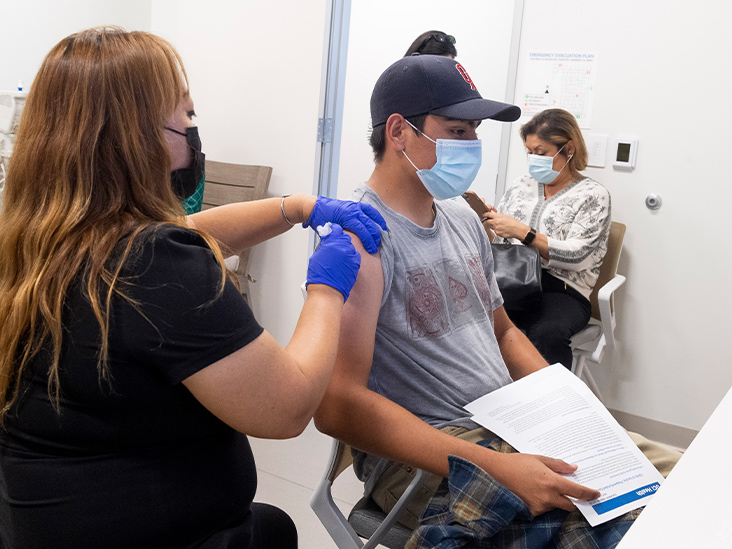
A 2021 news report on the expected US authorisation of the Pfizer-BioNTech COVID-19 vaccine for 12- to 15-year-olds. For current Australian advice, see health.gov.au and your GP.
This article was first published in May 2021 and reflects what was being reported in the United States at that time. Vaccine approvals, eligibility and recommendations have changed since then, and this page is not current advice. For up-to-date information about COVID-19 vaccination in Australia, including for children and teenagers, visit health.gov.au and speak with your GP.
In May 2021, federal officials told The New York Times that the US Food and Drug Administration (FDA) was expected to authorise the Pfizer-BioNTech COVID-19 vaccine for children and teens aged 12 to 15 within days.
In early April 2021, Pfizer-BioNTech had asked the FDA to amend its existing emergency use authorisation (EUA) to include this younger age group. At that time, the vaccine was authorised in the United States only for people aged 16 and over.
The FDA was reviewing data submitted by the companies. At the end of March 2021, Pfizer and BioNTech reported results from a phase 3 clinical trial in more than 2,000 adolescents aged 12 to 15. The companies reported very high efficacy in this age group and said the vaccine was generally well tolerated.
According to the companies, adolescents who received the vaccine produced strong antibody responses, similar to those seen in earlier trials among people aged 16 to 25.
Paediatric specialists quoted in US reports at the time described the development as welcome news, noting that children in the 12 to 15 age group were relevant both to catching and to spreading COVID-19.
The original EUA for the vaccine was granted in December 2020 after a public meeting of the FDA’s Vaccines and Related Biological Products Advisory Committee (VRBPAC). Because the 2021 request was an amendment to an existing EUA, another meeting of that committee was not expected.
Once the FDA amended the EUA, the vaccine advisory committee of the Centers for Disease Control and Prevention (CDC) was due to meet and decide whether to recommend the vaccine for 12- to 15-year-olds.
At the time, Pfizer’s paediatric study was enrolling children from 6 months to 11 years old. Moderna had an adolescent trial under way and was recruiting children from 6 months to 11 years old for another study.
Experts quoted in 2021 noted that, although children and teens were less likely to be hospitalised with COVID-19, their risk was not zero.
Paediatricians quoted in US reports pointed to a study finding that young people could develop long-term symptoms after infection, such as fatigue, headache and heart problems, lasting weeks to months. They also noted that children and adolescents could develop multisystem inflammatory syndrome (MIS-C), even after an infection without symptoms. MIS-C can affect a child’s heart, lungs, kidneys, brain, skin, eyes and digestive organs.
Doctors also described the indirect effects of the pandemic on young people, such as missing in-person school, time with friends and group sport. Public health specialists quoted at the time hoped authorisation for this age group would encourage communities to reopen activities for young people and support a more normal school year.
Vaccinating children and teenagers was also seen at the time as part of building community-wide protection and reducing hospitalisations. In 2021, a large share of US adults had not yet received a vaccine dose. Research at the time suggested vaccinated people might be less likely to pass the virus on, although scientists were still studying this.
Epidemiologists cited in US coverage noted that children can spread the virus to others, and that vaccinating children in multigenerational homes could help protect adults in the household, especially those who were unvaccinated or had weakened immune systems.
Paediatric specialists in US reports also said that wider vaccination could help bring the pandemic to an end sooner. They pointed out a practical challenge: the vaccine’s ultra-cold storage requirements limited where it could be given, and many parents would have preferred their child to be vaccinated at a familiar paediatric clinic rather than a pharmacy or large venue.
With much of the world still struggling to vaccinate high-risk people in 2021, expanding access in the United States to adolescents, who have a lower risk of severe illness, raised ethical questions.
Natalie Dean, PhD, then an assistant professor of biostatistics at the University of Florida, wrote on Twitter that adolescents should be able to access the vaccine, but that the ethics of vaccinating them ahead of high-risk adults in other countries also needed to be considered.
By mid-April 2021, The Washington Post reported that nearly half of the COVID-19 vaccine doses given worldwide had gone to high-income countries.
Some of the paediatric specialists quoted at the time said it was important to vaccinate vulnerable populations in other countries as well, and that this could happen in parallel with vaccinating children and teens in the United States. The Kaiser Family Foundation also outlined actions the US government could take to support fairer global access to COVID-19 vaccines.
As a home care and disability support provider, we follow current Australian public health advice rather than historic overseas reports. If you have questions about vaccination for yourself or a family member, talk with your GP and check health.gov.au for the latest information.

 Relationships (7)
Please Login or Sign up to be able to comment